Long Term Benefits Of Montessori Education
Choosing the right educational foundation is one of the most important decisions a family can make. Montessori education, developed by Dr. Maria Montessori, is grounded in decades of observation, research, and practice centered on how children naturally learn best. At Monarch Montessori School, we see every day how this child-centered approach supports not only academic growth, but also the development of confident, capable, and compassionate individuals. The long-term benefits of Montessori education extend far beyond the classroom, shaping students into adaptable learners and thoughtful members of society.
Below, we explore the enduring advantages of a Montessori education and how they support children throughout their lives.
Building Strong Executive Function
Executive function refers to a set of mental skills that include focus, self-control, planning, organization, and problem-solving. Montessori classrooms are intentionally designed to strengthen these skills from an early age. Children choose their work, manage their time, follow multi-step processes, and complete tasks independently or collaboratively.
Because Montessori materials are self-correcting, students learn to identify and fix their own mistakes rather than relying on constant adult intervention. This nurtures self-regulation and persistence. Over time, children develop the ability to concentrate deeply, set goals, and carry tasks through to completion, skills that are essential for success in higher education, careers, and everyday life.
Students learn:
- Self-regulation: Students learn to manage their own time early on.
- Focus: Lengthy work periods build deep concentration skills.
- Planning: Choosing activities requires thinking ahead.
Developing Superior Social Skills
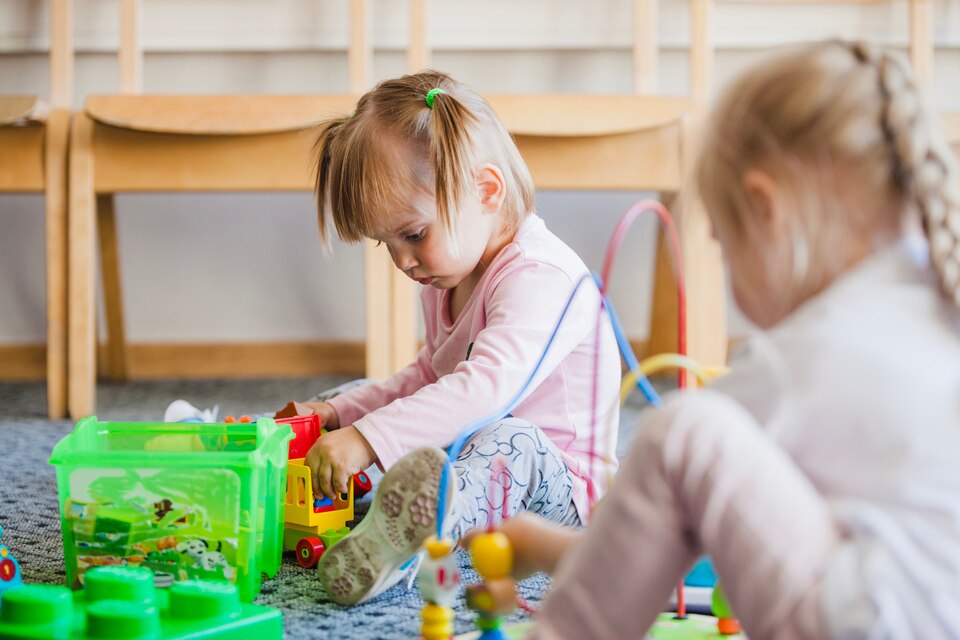
Montessori classrooms are typically multi-age, allowing children to learn alongside peers who are older and younger than themselves. A room with toddlers has children from the age of 18 months to 3 years old This structure naturally encourages cooperation, empathy, leadership, and respectful communication. Younger children learn by observing older classmates, while older students reinforce their understanding by mentoring others.
Rather than competing for grades or rewards, students are encouraged to collaborate and support one another. Conflict resolution is approached with guidance and respect, helping children learn to express their feelings, listen to others, and work toward peaceful solutions. These experiences foster strong interpersonal skills that translate into healthy relationships throughout life.
At Monarch Montessori School our curriculum focuses on
- Collaboration: Projects often require working together to solve problems.
- Conflict resolution: Teachers guide kids to solve disputes independently.
- Empathy: Helping younger peers fosters deep emotional intelligence.
Contact us today at 973-928-3605 to learn more about our school and our standards.
Fostering A Lifelong Love Of Learning
One of the most profound long-term benefits of Montessori education is the cultivation of intrinsic motivation. In a Montessori environment, learning is driven by curiosity rather than external rewards or pressure. Children are free to explore topics that genuinely interest them, leading to deeper engagement and understanding.
This approach helps students associate learning with joy, discovery, and personal growth. Instead of asking, “Is this going to be on the test?” Montessori-educated students are more likely to ask, “Why does this work?” or “What can I learn next?” This love of learning often persists into adulthood, supporting continuous personal and professional development.
Our goal is to foster:
- Curiosity: Questions are encouraged rather than just supplying answers.
- Ownership: Students take charge of their own educational journey.
- Engagement: Hands-on materials make abstract concepts concrete.
Adaptability And Creative Thinking
The modern world is constantly changing, and success increasingly depends on adaptability and creative problem-solving. Montessori education prepares children for this reality by emphasizing flexible thinking and real-world applications of knowledge.
Open-ended materials, hands-on exploration, and project-based learning encourage students to think critically and creatively. They learn that problems can have more than one solution and that experimentation is a valuable part of the learning process. As a result, Montessori students are often comfortable navigating new situations, thinking innovatively, and responding thoughtfully to challenges.
Children learn through:
- Innovation: Freedom to explore leads to unique problem-solving methods.
- Flexibility: Moving freely in the classroom builds physical agility.
- Resilience: Trial and error is viewed as part of learning.
Cultivating Independence And Confidence
Independence is a cornerstone of Montessori philosophy. From a young age, children are encouraged to do things for themselves: pouring water, preparing snacks, choosing work, and caring for their environment. These daily opportunities build practical life skills and a strong sense of self-efficacy.
In the end students learn:
- Self-trust: Children learn to trust their own judgment.
- Competence: Mastering practical skills builds real self-esteem.
- Decisiveness: Regular choices in class make decision-making easier.
Internalizing A Sense Of Order
At the same time, Montessori classrooms emphasize order and structure. Materials are carefully arranged, routines are consistent, and expectations are clear. Children internalize this sense of order, which supports logical thinking, time management, and emotional security. Together, independence and order help children develop genuine confidence rooted in competence and responsibility.
- Organization: Keeping spaces tidy becomes a natural habit.
- Clarity: An orderly environment reduces mental clutter.
- Efficiency: Knowing where things belong saves time and energy.
Together, independence and order help children develop genuine confidence rooted in competence and responsibility. At Monarch Montessori School, we emphasize building these skills together.
Academic Proficiency And Math Skills
Montessori education is often misunderstood as being less academically rigorous, but research and experience show the opposite. Montessori students frequently demonstrate strong academic outcomes, particularly in mathematics.
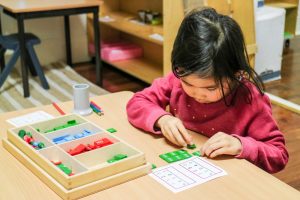
Concrete, hands-on materials allow children to grasp abstract concepts in a meaningful way. In math, students progress from tactile experiences, such as counting beads or manipulating number rods to symbolic understanding at their own pace. This solid foundation supports deep comprehension rather than rote memorization.
Because children are not rushed or held back by rigid timelines, they can master concepts fully before moving on. This individualized approach often leads to strong academic confidence and long-term proficiency across subjects.
- Conceptual grasp: They understand what numbers mean, not just rules.
- Early literacy: Phonics-based approach often leads to early reading.
- Critical analysis: Students learn to analyze facts rather than memorize.
At Monarch Montessori School, our programs support student development including students who have learning disabilities like ADHD. We would love to connect with you to show you how our school works. Take a self-tour virtually or schedule a tour of our school today.
Emotional Maturity And Peace
Emotional intelligence is just as important as academic knowledge, and Montessori education places a strong emphasis on emotional development. Grace and courtesy lessons, mindfulness of others, and respect for the learning environment help children become aware of their emotions and how their actions affect those around them.
Students are encouraged to express themselves calmly, resolve conflicts peacefully, and take responsibility for their behavior. Over time, this fosters emotional maturity, resilience, and a sense of inner peace. Montessori-educated individuals often carry these qualities into adulthood, contributing to balanced mental health and positive social engagement.
We focus on:
- Self-awareness: Identifying emotions is the first step to managing them.
- Coping skills: Practical tools help manage stress and anger.
- Respect: Valuing others is woven into every activity.

Long Term Benefits Of Montessori Education
The long-term benefits of Montessori education are holistic and far-reaching. By supporting cognitive, social, emotional, and practical development, Montessori prepares children not just for school, but for life.
At Monarch Montessori School, our goal is to nurture capable, compassionate, and confident learners who are equipped to thrive in an ever-changing world.A Montessori education is more than an educational choice. It is an investment in a child’s lifelong growth, well-being, and potential. Visit our school today at 2 Newark Pompton Turnpike, Little Falls, NJ 07424.